Why anyone watches aircraft in the first place
If you've never done it, the appeal of ADS-B can be hard to explain. "You can already see flights on a phone app" is the usual reaction. And that's true — Flightradar24, FlightAware and the rest will happily show you a map full of aircraft, for free, right now.
But here's the thing the apps don't tell you: you're not watching the sky. You're watching a database. Those maps are assembled from a global network of other people's receivers, aggregated on a company's servers, filtered through commercial and regulatory blocklists, and handed back to you over the internet. It's someone else's picture of the sky, cleaned up and served to you.
When you run your own receiver, something different happens. A 1090 MHz signal leaves an aircraft's transponder, travels through the air, and lands on your antenna. Your radio. Your roof. There is no server in the middle, no aggregator, no filter list deciding what you're allowed to see. The aircraft overhead announced itself, and you — personally — caught it.
That difference sounds small until you've felt it. It's the same reason people fish instead of buying fish. The thing on the plate is identical; the provenance is everything. The data on a tracking app and the data your own antenna pulls down are the same numbers — but one of them you earned.
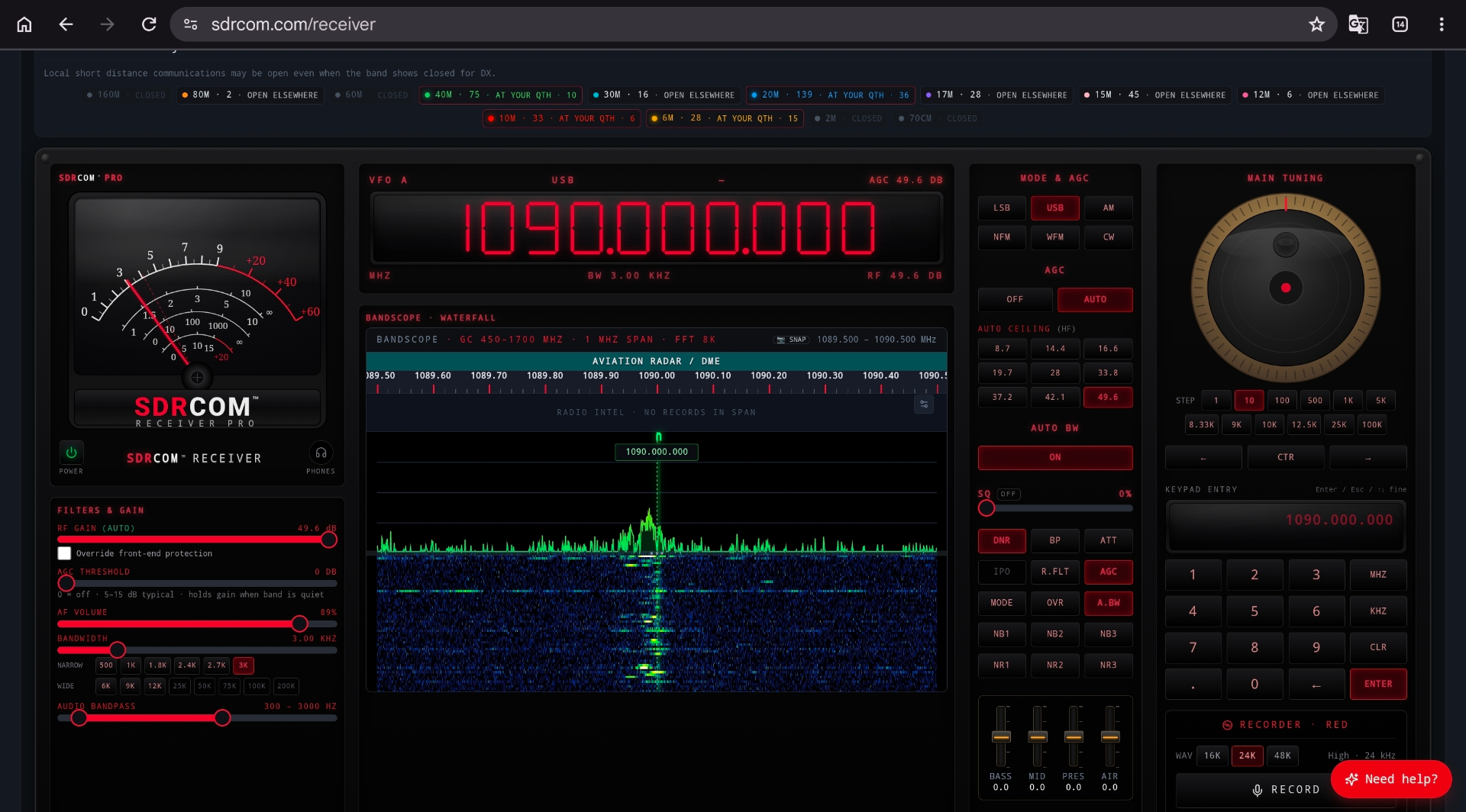
And once you're listening to your own RF, the rest of the hobby opens up:
- The invisible made visible. There is a constant, invisible river of radio energy passing through the space above your head, every second of every day. Your senses can't detect a photon of it. A receiver reveals it — and ADS-B is the most legible reward there is, because abstract radio noise becomes named aircraft on a map, in real time.
- The collection. Like trainspotting before it, plane-watching is partly about the catalogue: the rare type, the unusual registration, the military or government aircraft the commercial apps quietly omit, the farthest contact you've ever logged.
- The engineering game. For a huge slice of operators, the planes are almost beside the point — the real sport is maximising the station. Antenna height, low-noise amplifiers, bandpass filters, chasing range records. ADS-B is the perfect proving ground because the results are instant and measurable.
- Transparency. Some people simply believe the sky should be observable without a paywall or a permission slip. Your own receiver answers to no one.
What a good ADS-B engine actually does
An ADS-B engine pulls ADS-B and Mode S transmissions off 1090 MHz and turns them into a live, three-way picture of your airspace. The three views are the heart of it, and they're built to be looked at, not just read.
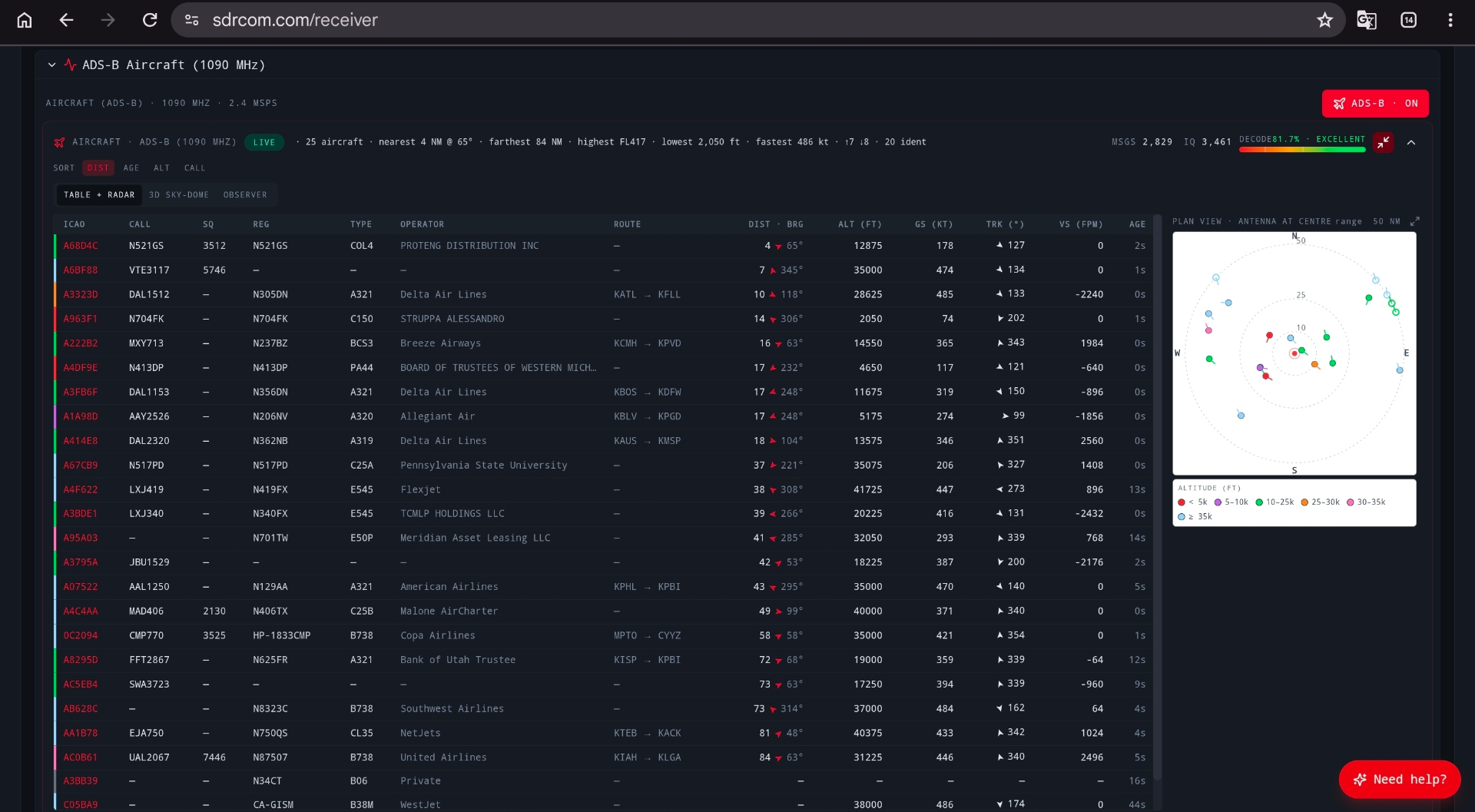
1. Table + radar
The classic view: a live, sortable list of every aircraft in range — ICAO, callsign, registration, type, operator, route, distance and bearing, altitude, ground speed, track, vertical speed, age — alongside a plan-view radar dial with the antenna at the centre. Aircraft are colour-coded by altitude band, so a single glance tells you who's low and who's at cruise. As an aircraft drifts out of range, it fades out of the picture rather than vanishing abruptly — a small touch that makes the airspace feel alive rather than mechanical.
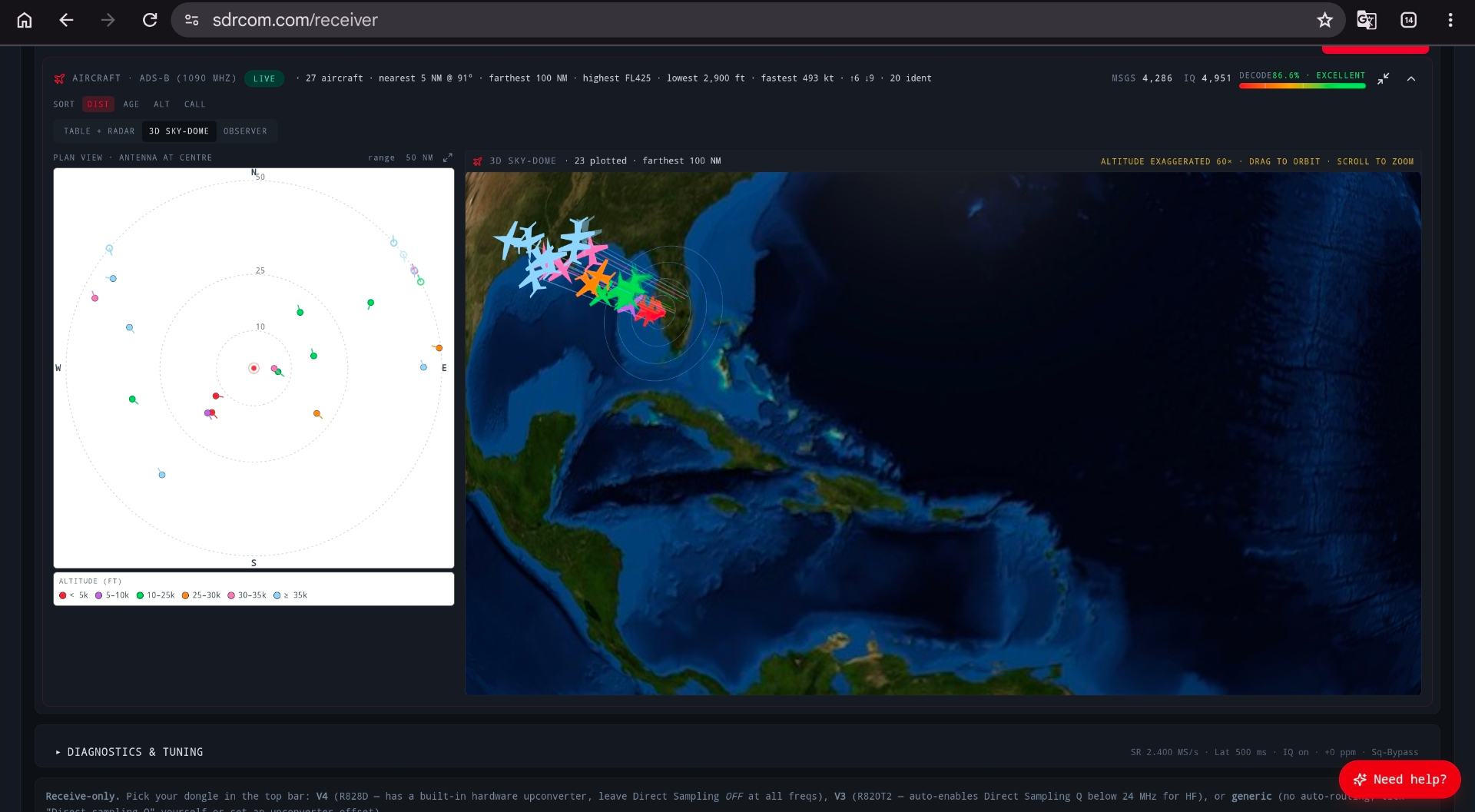
2. 3D sky-dome
This is the one that tends to win people over. Your airspace rendered on a true 3D globe, aircraft plotted at their real positions and altitudes, colour-coded by height so the layering of the sky is visible at a glance. Drag to orbit, scroll to zoom. You're not reading coordinates — you're seeing the shape of the traffic over your region.
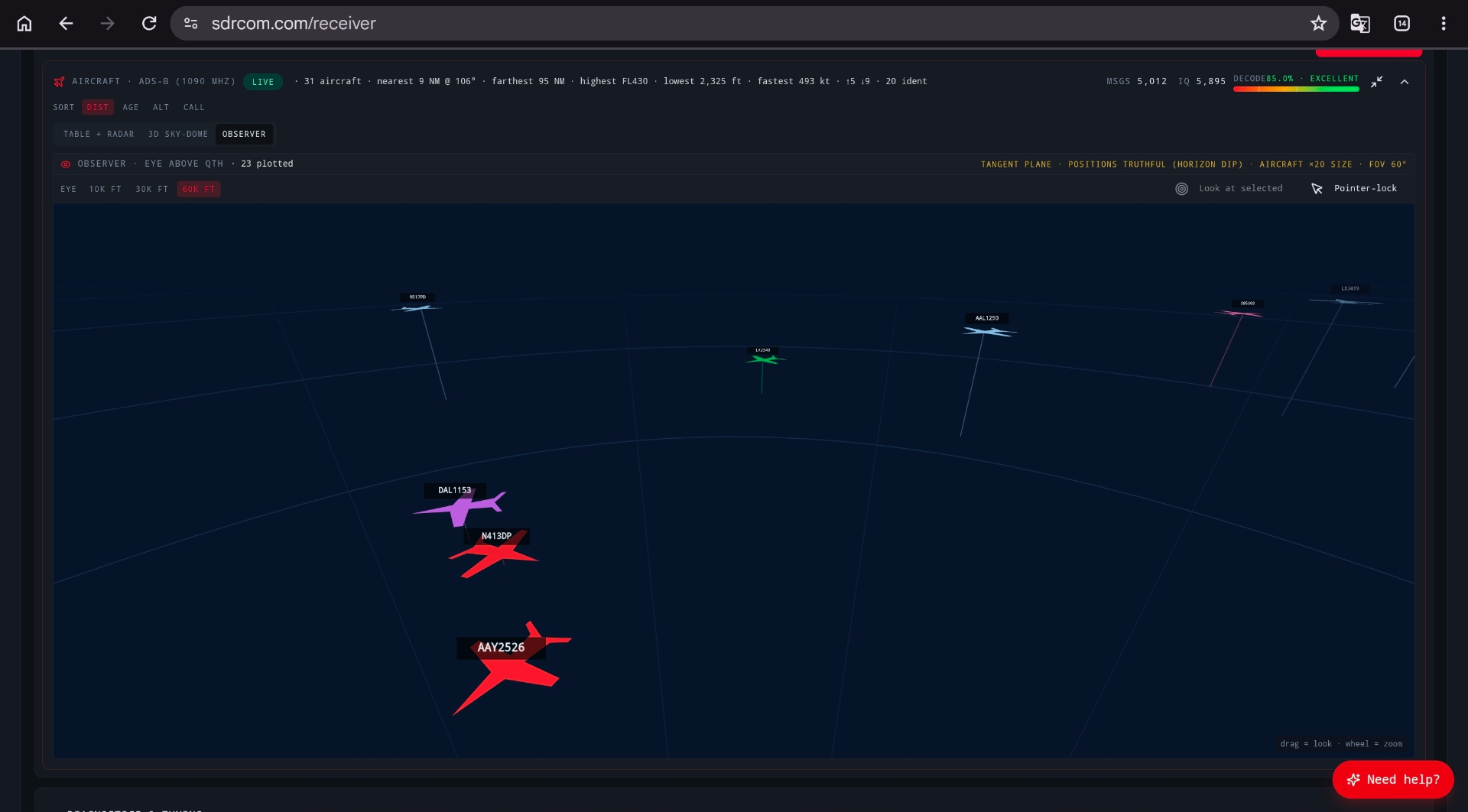
3. Observer
Step inside the airspace. Place your eye at 10,000, 30,000 or 60,000 feet and sit among the aircraft, looking out at them with truthful positioning (including horizon dip). It's the closest thing to standing on a cloud and watching the traffic go by. There's a genuine sense of presence to it that a flat map can't give you.
On top of the views, a complete engine decodes the full picture: positions via CPR, altitude, velocity and track, vertical rate, callsigns, and transponder squawk codes, including live monitoring for the reserved emergency codes.
The squawk feature — and what trustworthy looks like
The squawk lane decodes the four-digit transponder code each aircraft is transmitting and displays it in the table. Most of the time you'll see ordinary codes — 1200 for VFR traffic in the US, and the discrete codes air traffic control assigns to airliners.
A well-built engine also watches for the reserved emergency codes and flags them: 7500 (hijack), 7600 (radio failure), 7700 (general emergency), plus 7777 (military intercept), which is usually treated as a distinct amber state rather than a red alarm because it isn't a civilian distress code.
The design philosophy worth holding tools to is this: the alert should fire only on the exact reserved codes — nothing else. A code like 7770 or 7444 starts with sevens but is a perfectly ordinary discrete assignment. A monitor that cries wolf — that flags anything in the "77" neighbourhood — quickly becomes a monitor you learn to ignore, and then the one real emergency gets dismissed as noise. Better that the alert mean something.
The same goes for honesty about limits. A brief or noisy emergency frame from an aircraft the decoder hasn't yet confirmed should be dropped on purpose rather than shown with a guessed identity, because a misattributed emergency is worse than a missed one.
Does it actually perform?
Fair question — a pretty 3D globe is worthless if the decode underneath it is weak. Running an inexpensive RTL-SDR at a 2.4 MS/s sample rate, on a normal antenna, a modern engine should hold a steady decode rate in the mid-80s to mid-90s percent, rated "excellent," with no glitches, no dropouts and no stream restarts across long sessions. In live testing the better decoders track 30–40 aircraft simultaneously out past 100 nautical miles, with tens of thousands of messages processed without a stumble — and they hold their own against established professional tools driving big antennas, low-noise amplifiers and bandpass filters.
A closing thought
Whether the magic of watching your own sky is your thing or not, the engineering underneath ADS-B is real, the equipment is cheap, and the reward is unusually legible: abstract radio noise turned into named aircraft on a map, in real time, picked off the air by an antenna you own.
The sky above your head is talking. This is a good way to listen.
73 — and clear skies.